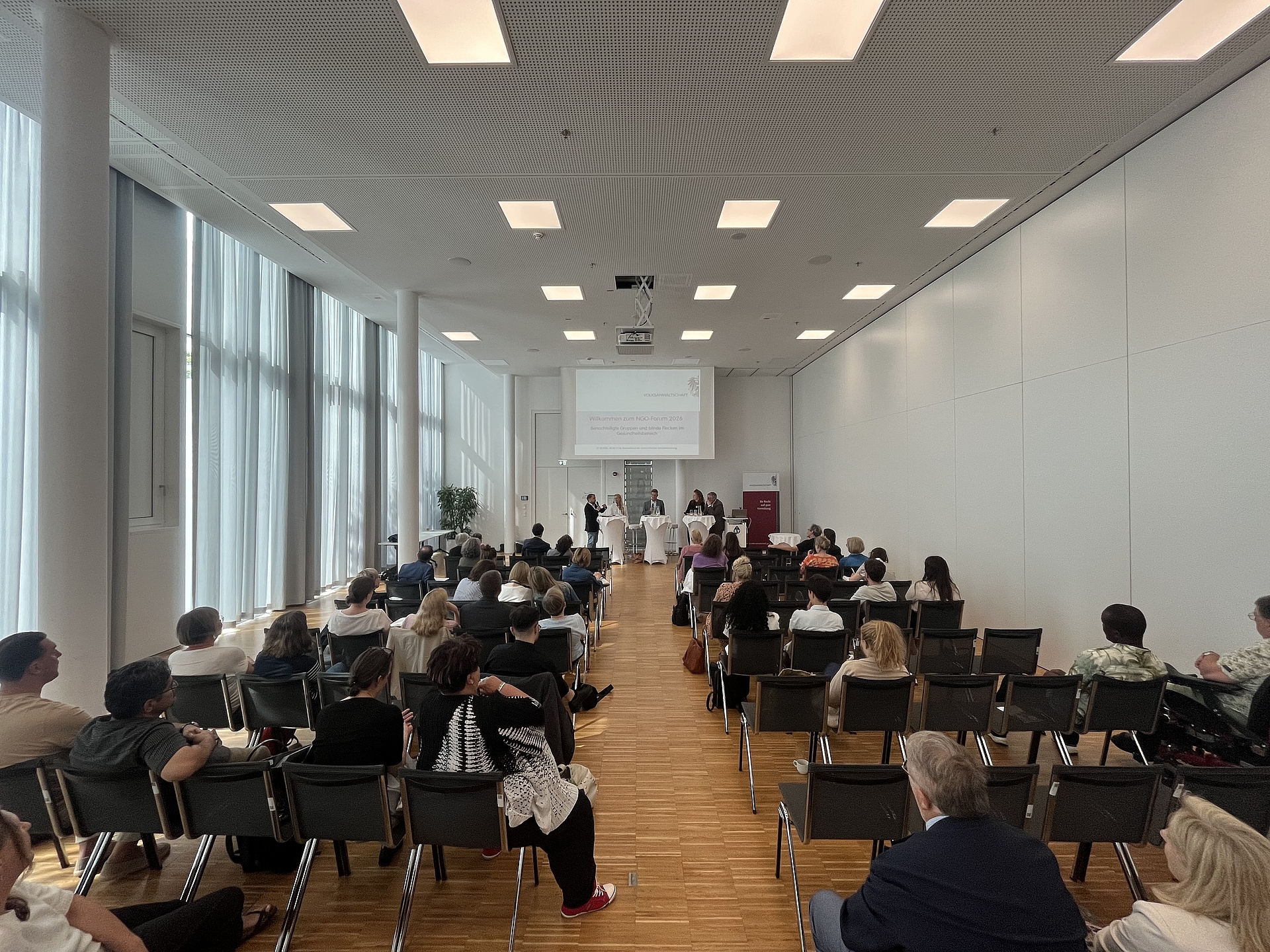
There is currently intense debate about healthcare reform. “It is important to focus on those people who are often overlooked in such discussions: disadvantaged groups such as those living in poverty, people with disabilities and women, and, last but not least, people affected by racism within the healthcare system,” said Ombudsman Bernhard Achitz, who chaired the NGO forum on 27 May at the premises of the Umbrella Organisation of Social Insurance Institutions: “People who belong to several of these groups are particularly affected, as discrimination does not occur in isolation.”
Every year, the Ombudsman’s Office organises an NGO forum on a specific topic, giving civil society the opportunity to engage in dialogue with federal and regional authorities, representatives of the social security system and, of course, politicians. In recent years, topics have included, for example, the still long-overdue enshrinement of fundamental social rights in the Constitution, or children’s rights. The Ombudsman’s Office has summarised and published the findings in conference proceedings: https://volksanwaltschaft.gv.at/berichte/ngo-forum-tagungsbaende/
Theresa Ekpa (ZARA): Racism happens – openly, but also in unquestioned routines
Theresa Ekpa from ZARA (ZARA – Civil Courage and Anti-Racism Work) drew attention to structural racism in the healthcare sector. She referred to the 2024 Racism Report: When Racism Makes You Ill (LINK). “Racism happens – not only actively and openly, but in the form of unconscious routines that are not scrutinised enough,” said Ekpa.
A specific example from ZARA’s counselling practice: a patient was suffering from extreme kidney pain, but her GP did not take her seriously. She was accused of exaggerating – because of her ethnic background. It later transpired that she had an advanced-stage tumour, and one of her kidneys had to be removed.
We must always ask, says Ekpa, “Who is believed? How accessible are channels for making complaints? How much racism is fundamentally embedded in medicine – in training, in medical technology, …?” Take dermatology, for example: textbook images almost always show white skin – how skin conditions appear on darker skin is not taught. Take pulse oximeters, for example: they are calibrated for white skin; on darker skin, they only trigger an alarm later.
The term ‘medical gaslighting’ refers to situations where pain is not taken seriously, symptoms are ignored, and examinations are not carried out – or are carried out inadequately – because of underlying prejudices. Although formal complaints procedures do exist, they are difficult to access due to language barriers, a lack of knowledge or a lack of trust.
One must always ask: ‘How is racism embedded in training and standards? Knowledge is not neutral or objective. Medicine needs greater competence in addressing racism. What is needed is better training, better access to complaints procedures and clear standards within institutions on how to deal with cases of racism. And, as Ekpa says: “We need better research and better data collection – because everything we know at present is based on experiences and reports.”