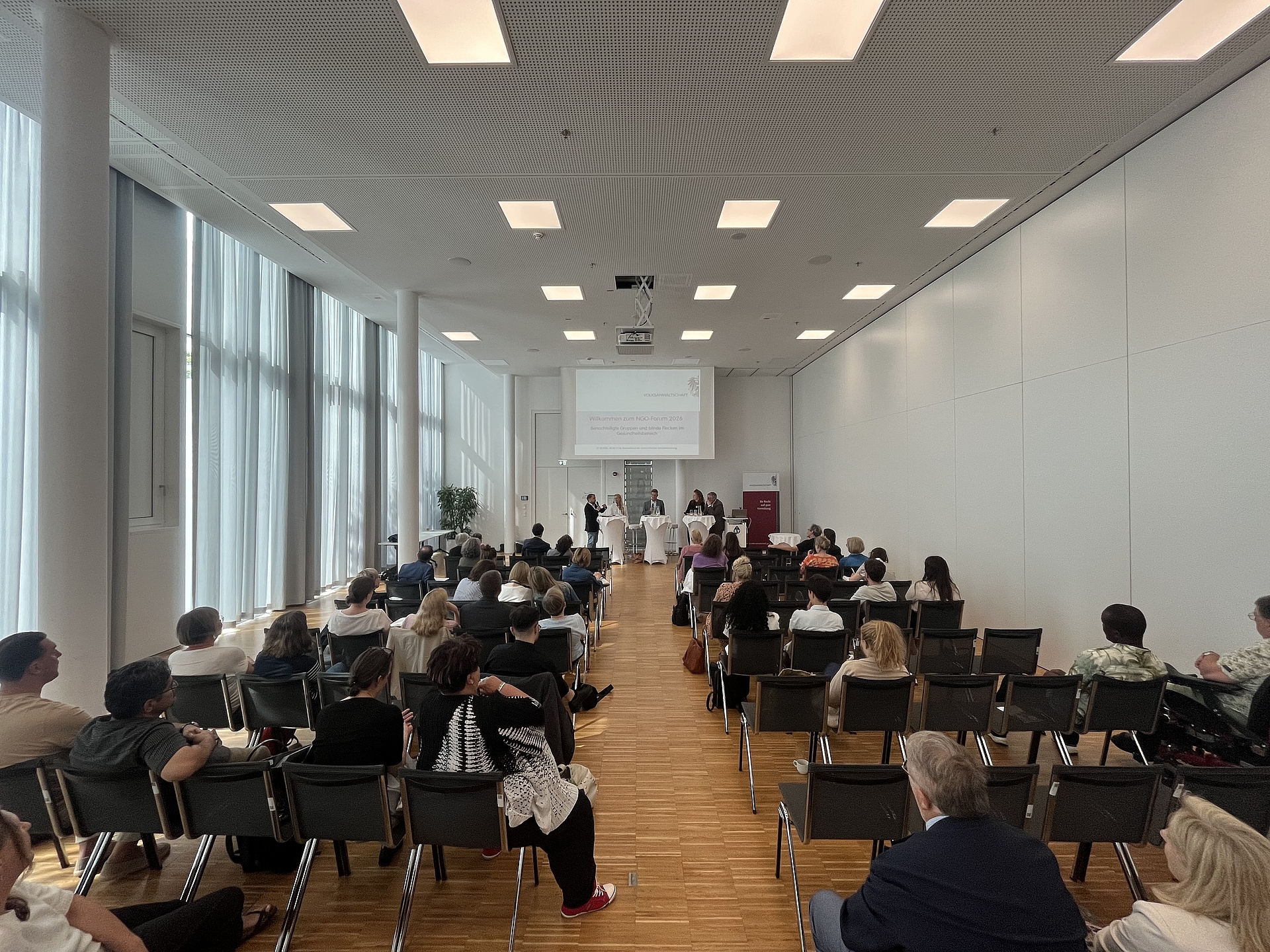
There is currently intense debate surrounding healthcare reform. “It is important to focus on those people who are often overlooked in such discussions: disadvantaged groups such as those living in poverty, people with disabilities and women, and, last but not least, people affected by racism within the healthcare system,” said Ombudsman Bernhard Achitz, who chaired the NGO forum on 27 May at the premises of the Federation of Social Insurance Institutions: “People who belong to several of these groups are particularly affected, as discrimination does not occur in isolation.”
Every year, the Ombudsman’s Office organises an NGO Forum on a specific topic, giving civil society the opportunity to engage with federal and state authorities, representatives of the social insurance system and, of course, politicians. In recent years, topics have included the still long-overdue enshrinement of fundamental social rights in the Constitution, or children’s rights. The Ombudsman’s Office has summarised and published the results in conference proceedings: https://volksanwaltschaft.gv.at/berichte/ngo-forum-tagungsbaende/
Poverty Conference: The system has not just blind spots, but black holes
“The lower the income and social status, the greater the risk of illness, for example diabetes, depression or back pain. But it is not only the burdens that are unevenly distributed, but also the resources to cope with them,” said Martin Schenk of the Poverty Conference: “The richest ten per cent live ten years longer than the poorest ten per cent.”
People living in poverty are now also disproportionately affected by inflation. Schenk: “We are all weathering the same storm, but we are not all in the same boat: some in a yacht, others in a nutshell.” Whilst people with money can switch to private healthcare when there are gaps in the state health insurance cover, people without money even forego urgently needed treatment: they do not go to the dentist because they are afraid it might be expensive – after all, the health insurance does not cover many services, particularly in the dental sector. “Should I pay the excess for dental implants or the rent? What use are the most beautiful teeth to me if I end up back on the streets?” a woman affected by poverty told Schenk.
However, the starting point for improvements often lies not in the healthcare system itself, but in social or education policy, according to Schenk: “Children with chronic illnesses are disproportionately likely to live in single-parent households. But there are too few nursery places, particularly for them.” Then the mother (or father) cannot go to work, poverty becomes entrenched, and health suffers as a result.
Brigitte Heller from the Lichterkette association said, “There aren’t just blind spots in the healthcare system, but black holes!” Social security for people with chronic illnesses involves assessment appointments, for example for care allowance or early retirement. “For people with mental health conditions, these assessments are very difficult; they have to prove, so to speak, that they are ill. People with anxiety disorders are often barely able to attend assessment appointments.” Assessors need to be better trained, and ideally, all assessments should be carried out by an external assessment centre.
Whilst drug shortages mean that people with money can in some cases obtain substitutes on the open market, for people with mental health conditions they can even lead to death – the issue of suicidal thoughts when psychotropic drugs are unavailable. People living in poverty cannot obtain the necessary medication themselves elsewhere.
In the psychiatric sector, involuntary treatment due to a risk to oneself or others is a major issue, particularly among young people. “If there were enough staff, many patients could be calmed without coercive measures or psychotropic drugs,” says Heller, seeing a link here too with funding.
The right to health is enshrined in the Convention on Human Rights. But, as Heller puts it: “Rights are all well and good, but how can I enforce them? Austria hasn’t even enshrined basic social rights in its constitution – that’s a huge blind spot!”