


"Pain must be treated immediately. This is only possible if it is recognised in good time," says Ombudsman Bernhard Achitz: "In older people with dementia, cognitive impairments or communication difficulties, the risk of pain being overlooked is particularly high. If people are unable to express their pain, this can also lead to violence."
Pain that is not recognised cannot be treated. For this reason, the Ombudsman Board and its commissions (together they form the National Preventive Mechanism - NPM) have focussed on pain management during their inspection visits to retirement and nursing homes.
Another topic was palliative care. The aim is to provide nursing home residents with quality of life, holistic pain management and a self-determined, dignified death. The "European Charter of Patients' Rights" includes the right to avoid unnecessary suffering and pain and mentions access to palliative treatment as an example.
Failure to treat pain also violates the rights to health, physical and mental integrity guaranteed in the UN Convention on the Rights of Persons with Disabilities (CRPD) and, in serious cases, the right to protection from violence and the right to protection from degrading treatment.
From July 2022 to September 2023, the commissions visited a total of 123 facilities in all federal states as part of the main audit. They spoke to 1,511 residents and inspected their documentation.
Major deficits in pain management
In a quarter of the retirement and nursing homes visited, there was no systematic, documented pain management or no measures were in place to recognise, prevent and treat pain. In one in five facilities, no pain assessment tools were used, neither for dementia patients nor for cognitively capable residents. There is far too little training for staff on the subject of pain.
"Pain must be recorded systematically and in a standardised way for all residents," demands Achitz: "Standardised pain management is particularly necessary when caring for people with dementia or other cognitive or verbal impairments."
"Qualified healthcare and nursing staff have an important and central role to play in pain management," says Esther Kirchberger, a nursing scientist and member of a commission of the Austrian Ombudsman Board, who was also involved in the focus audit.
Professional pain management is implemented and controlled by qualified healthcare and nursing staff. "It is a professional duty. Pain management is part of the core competence of nursing, which is enshrined in the Healthcare and Nursing Act."
Positive examples have emerged, particularly in the area of alternative methods for pain relief (aromatherapy, cold and heat treatments, counselling, etc.). Qualified healthcare and nursing staff advise and decide on such complementary measures.
Painkillers are always available in many facilities for acute situations. The attending physicians are usually informed about changes in pain or side effects of treatments.
Doctors must prescribe pain medication specifically and in writing for the pain situation in question. Carers must not have a choice. Kirchberger: "However, it happens time and again that several medications are prescribed for pain and the specific pain situation or indication has not been specified by the doctor. There are also cases in which the doctor does not prioritise which of several prescribed medications should be used first."
"In the best case scenario, pain management includes various treatments and procedures, and it should be adapted to the needs and circumstances of the residents in order to improve their quality of life," says nursing scientist Kirchberger: "Training and further education on pain management is a prerequisite and must be anchored in the training plan in the facilities in order to generate new knowledge and implement it in everyday working life." Managers have a responsibility to communicate transparently with their employees.
Palliative care: good care, more preventative dialogue and training needed
The commissions' focus reviews have shown that the majority of facilities do not offer the option of assisted suicide. A few months ago, a report by the Human Rights Advisory Council of the Austrian Ombudsman Board attracted attention. According to the report, care home providers must accept the possibility of assisted suicide without punishment for the seriously and terminally ill, as provided for in the Death Decree Act, out of respect for the free decision of residents. "However, assisted suicide must be the last resort. The Ombudsman Board is therefore calling above all for more investment in hospices, as the right to die with dignity cannot be realised without comprehensive counselling and palliative care services," says Ombudsman Achitz.
In the area of palliative care, the focus review has shown good provision. The conditions in the dying phase (involvement of relatives, various rituals), the cooperation of the nursing staff with external, specialised hospice teams, but also with other professional groups, or nutrition at the end of life were largely assessed positively. In almost all retirement and nursing homes (94%), the aim of the facility was to enable residents to die in their familiar surroundings. Above all, there is room for improvement in terms of "preparation" and everything that happens before the palliative phase begins. Preventive dialogues must be stepped up and more palliative care training is needed.
"Further training and information events with experts on the End of Life Decree Act and assisted suicide should definitely continue to take place in order to clear up uncertainties and ignorance among qualified nursing staff," says nursing scientist Kirchberger: "Providers should develop their own positions on the subject and communicate these clearly to their staff."
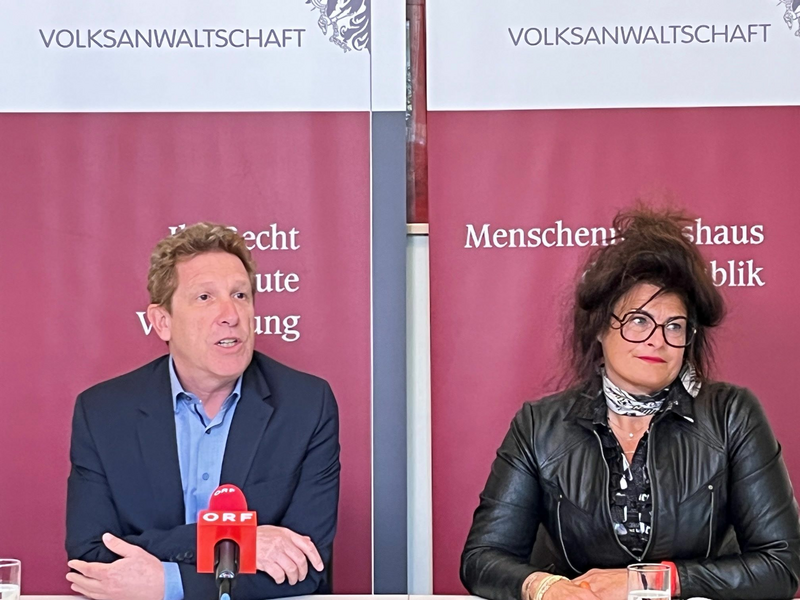 Ombudsman Bernhard Achitz and nursing scientist Esther Kirchberger, member of Commission 2, at the press conference.
