The planning of the cycle path, which in itself makes sense, was not thought through to the end. Signposts to cyclists crossing the road, which are also missing, would be an improvement. However, according to the cyclist, he had the impression that nobody was interested in the issue because the cycle path was so close to the edge of the city that it was almost in Lower Austria. The City of Vienna's transport agency had replied to the man that the traffic frequency on the road was too high for structural measures to protect cyclists. He had not been able to achieve anything either by intervening with the district council or the MA 46 responsible for traffic organisation, which is why he finally turned to the Austrian Ombudsman Board.
Nobody from the City of Vienna attended the studio discussion in "Bürgeranwalt". However, in a written statement, the district council of Donaustadt referred to the low frequency of cyclists crossing the road, which is why it was not possible to build a protective path there. The existing lane divider would make crossing much easier anyway. According to MA 46, no further measures are planned there. The expert from the Board of Trustees for Road Safety who was present during the programme also agreed with this point of view: The cycle path in Breitenleerstraße was mainly a low-ranking surface access route and the lack of a crossing in this case was covered by the legal situation. Nevertheless, there are also sensible measures there, such as providing the crossing with red road markings. In principle, however, a traffic light system would also be conceivable.
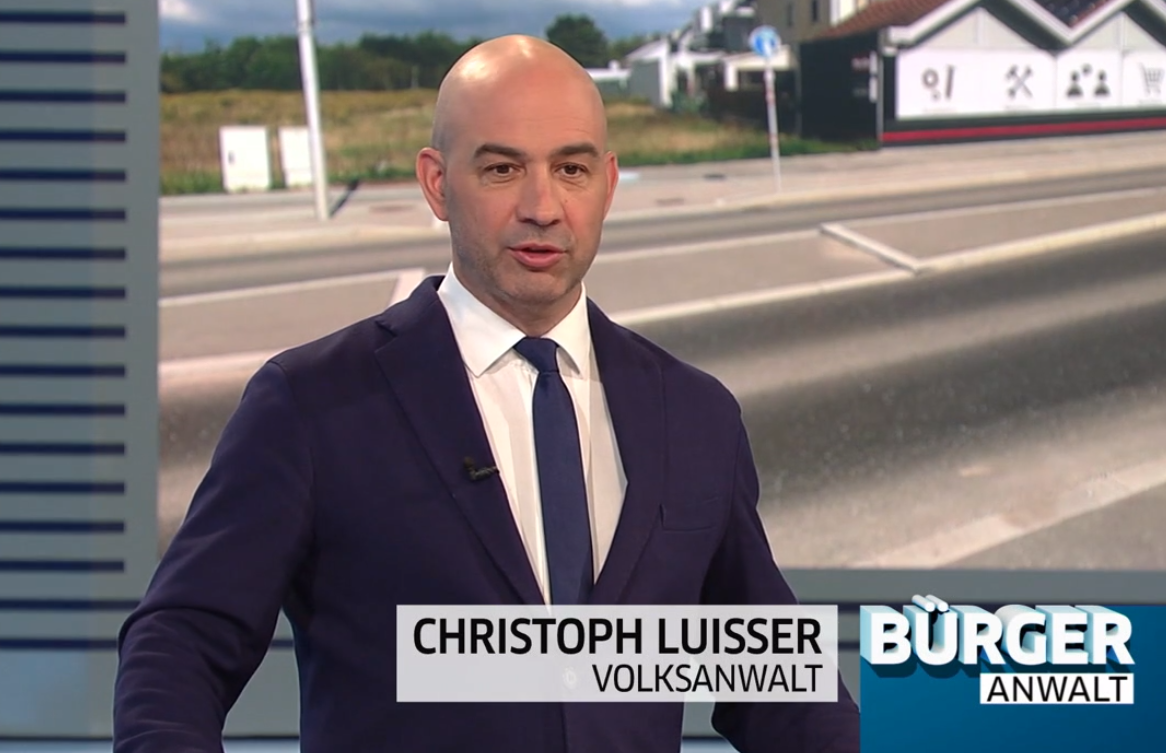
Ombudsperson Christoph Luisser criticised in the programme that no one from the City of Vienna had taken up the discussion. Although the cycle path in Breitenleerstraße was only built in 2022, the design was unfortunately only half-hearted and not well thought out. If a cycle path is built in such a way that nobody dares to cycle there, it should come as no surprise if the number of users falls short of expectations. "I looked at the cycle path myself, it's like a motorway," said the Ombudsperson. As a six-figure sum had already been spent, the gap in Breitenleerstraße should also be closed. Why this had not been done was completely incomprehensible to him, said the Ombudsperson. "There are still many gaps to be closed in Donaustadt, for example in Quadenstraße or Stadlauer Straße. With the low frequency of cyclists claimed by MA 46 and the district council, even a traffic light system with a push button cannot be a problem there. If the cycle path network is to be expanded, then please do it sensibly!" demanded Ombudsperson Luisser.
Follow-up: Game browsing damages young forest
A Carinthian family of forest owners contacted the Ombudsman's Office because, in their opinion, hunters were feeding the game in the forest too much and hunting too little, causing considerable damage to young trees. The Villach-Land district authority was not insisting enough on compliance with hunting plans. The authority stated that measures to protect forest areas had been imposed on hunters in the past. However, according to the family, this was not enough. Following an initial report in ‘Bürgeranwalt’ in January 2023, the situation had temporarily improved, as the then Ombudsman Walter Rosenkranz was able to report in September 2023. In the meantime, three female animals had to be shot before a stag could be shot, and cross-territory shooting plans had also been introduced.
This time, the family reported in ‘Nachgefragt’ that the damage caused by wild animals remained high and that intensive feeding of wild animals was even attracting game from the surrounding area; the hunters had not complied with repeated requests from the victims to refrain from doing so. The Villach-Land district administration stated that it had no authority to influence the culling plan or the feeding facilities. According to the hunting community, the broadcast of the case on ‘Bürgeranwalt’ had led to an improvement in relations, but unfortunately no improvements in the condition of the forest were yet visible.
Ombudsman Christoph Luisser was pleased that the district hunting master had also recognised an improvement since the Ombudsman's intervention, but said that more needed to be done: ‘If the hunters themselves say that the situation is not yet satisfactory, they need to get it under control.’