


"Scandals like the recent one involving the SOS Children's Villages keep popping up. I dare to say: it wouldn't have come to this if there had been uniform quality standards in residential groups throughout Austria," says Ombudsperson Bernhard Achitz. FICE Austria developed quality standards for residential child and youth care back in 2019. They deal with issues of participation, the preventive protection of minors from violence, dealing with danger, assaults and violence, healthcare and educational processes. "The FICE quality standards must become a mandatory programme in all facilities. Of course, this must also be funded accordingly," demands Achitz.
"FICE - Austria" is the Austrian section of the International Federation of Educational Centres (Fédération Internationale des Communautés Educatives - F.I.C.E.). It networks people and organisations and works to improve education outside the family.
'HANDBOOK for residential educational support'
"All those involved, from professional associations to the organisations that run the shared care homes and the federal states as supervisory authorities, agree: the quality standards are right and important. But they do not necessarily have to be applied," criticises FICE Austria President Christian Posch. "Good training is the basis for preventing abuses, or at least recognising them if they do happen. FICE Austria has therefore developed a comprehensive textbook: The 'HANDlungsBUCH für die stationären Erziehungshilfen - Band I' which describes the central tasks and fields of action of inpatient child and youth welfare in a compact, practical and professionally sound manner."
Binding professional cooperation in diagnostics, help planning and intervention
Posch sees the fact that every federal state regulates child and youth welfare differently as a problem. FICE Austria and the Austrian Ombudsman Board have long criticised the fact that the full application of the recognised standards fails due to the costs. Posch: "In addition to the standards, early and flexible support services for young people with challenging behaviour must be developed further. There needs to be verbalised professional cooperation in diagnostics, help planning and intervention. Personnel resources and labour law principles are required."
FICE standards unknown in half of the centres
A focus audit as part of the Ombudsman Board's preventive human rights monitoring, published three years ago, revealed that staff in only 53 per cent of the facilities visited were aware of the FICE standards. Ombudsperson Achitz: "Almost half of the facilities therefore lack in-depth knowledge of the standards. It would be important for every organisation to assign responsibility for implementing and complying with the standards to at least one person. However, this was only the case in 47 per cent of facilities at the time of the focus audit."
"Round table" must bring uniform standards and staffing ratios
The "greatest possible harmonisation of child and youth welfare" and a round table were recently announced in parliament. "The round table would not be necessary if the demands of the Ombudsman Board and FICE, which have been on the table for years, had been implemented: uniform standards for child welfare, group sizes, staff training and staffing ratios. The FICE quality standards must become a mandatory programme in all facilities. Of course, this must also be funded accordingly." Should there nevertheless be a round table, the Ombudsman Board is of course prepared to reiterate its position there too. "In addition to the authorities, child and youth welfare centres and the Ombudsman Board, the Care Leaver Association, DÖJ, FICE Austria, schools, the police, Neustart, universities and universities of applied sciences as well as professional associations should also be invited," says Achitz.
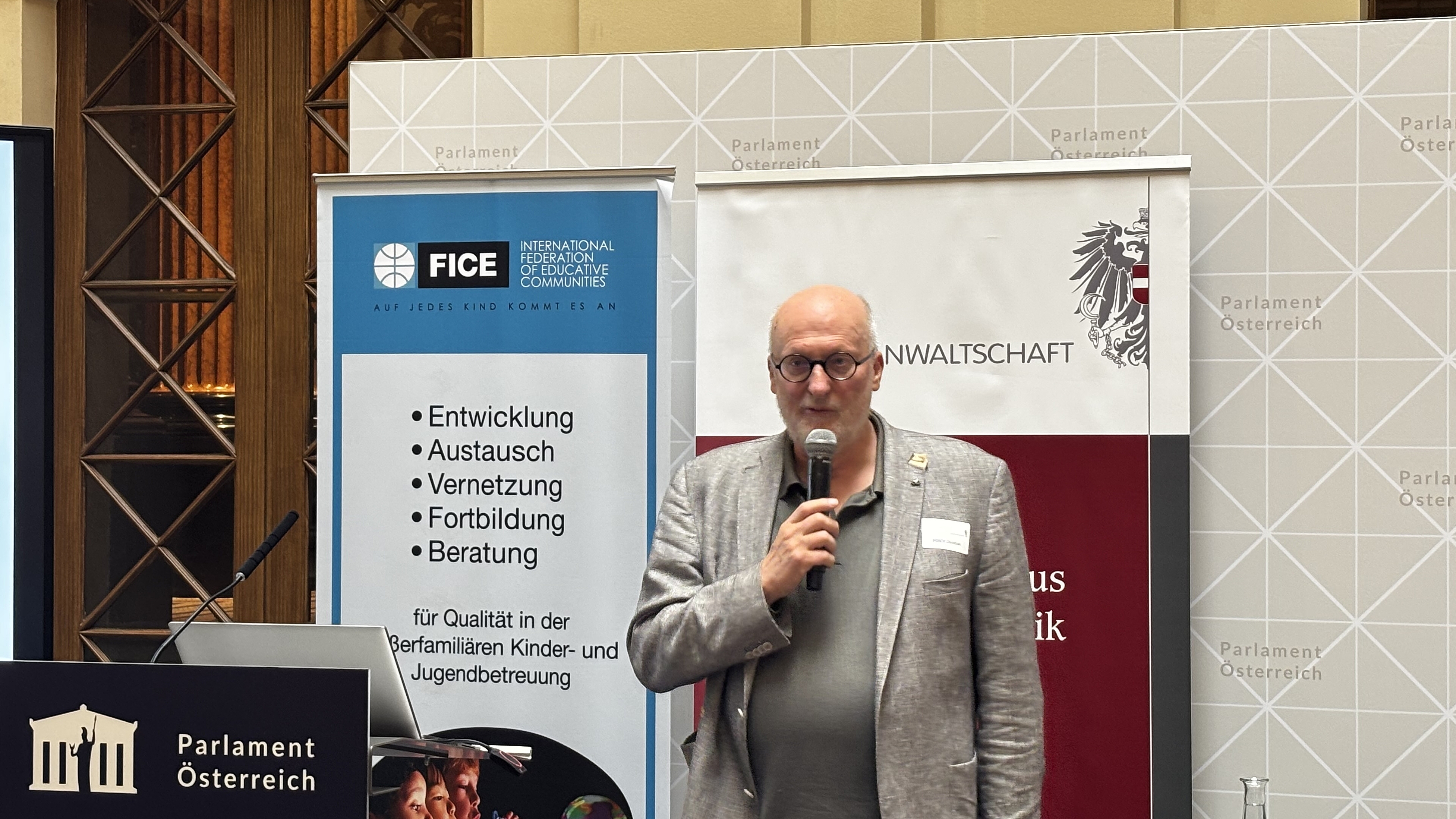 FICE Austria President Christian Posch at the FICE Austria symposium on 8 October 2025 in Vienna's Palais Epstein